
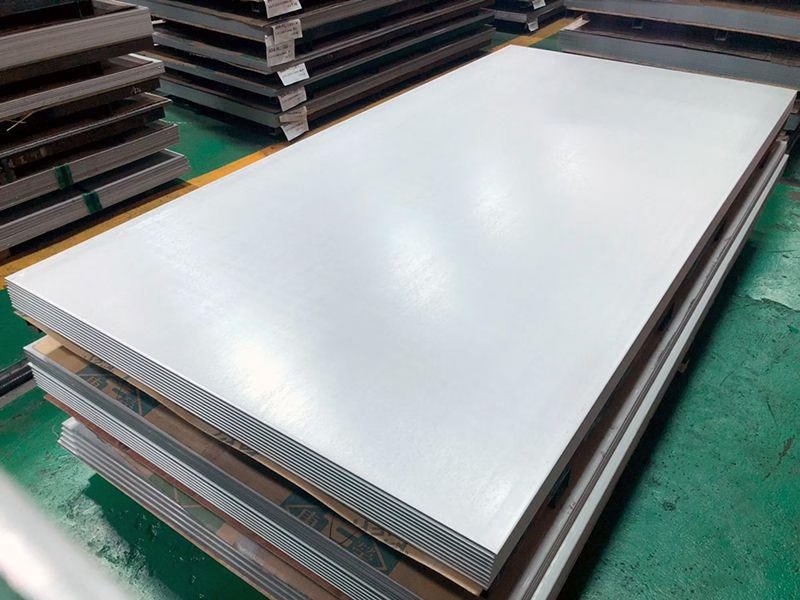
316 Stainless Steel Plate
AISI 316 (UNS S31600) molybdenum-bearing austenitic stainless steel plate with superior corrosion resistance in chloride and marine environments. Contains 2-3% Mo for enhanced pitting resistance. Thickness 3-200mm, width up to 2500mm, PREN ≥24. Mill test certificate with Mo verification provided.
| Material | Austenitic Stainless Steel (Molybdenum-Bearing) |
|---|---|
| Grade / Standard | AISI 316 / UNS S31600 |
| Thickness | 3mm - 200mm |
| Width | 1000mm - 2500mm |
| Length | 2000mm - 12000mm |
| Delivery Condition | hot_rolled / cold_rolled / quenched_tempered |
| Surface Treatment | bare / polished |
| MOQ | 1 Ton |
| Delivery Time | 12-30 Days / In Stock for Common Sizes |
| Loading Port | Tianjin / Shanghai / Qingdao / Ningbo |
Overview of 316 Stainless Steel Plate
AISI 316 is a molybdenum-bearing austenitic stainless steel grade offering significantly superior corrosion resistance compared to standard 304, particularly in chloride environments, marine atmospheres, and chemical processing applications. Specified under ASTM A240 / EN 10088-2 standards with UNS designation S31600, 316 stainless steel plate contains nominally 16-18% chromium, 10-14% nickel, and 2-3% molybdenum, providing the characteristic austenitic microstructure with enhanced resistance to pitting corrosion, crevice corrosion, and stress corrosion cracking in harsh environments. The molybdenum addition is the key differentiator, creating a more stable passive film and significantly improving performance in saline, acidic, and industrial chemical exposures.
316 stainless steel plate is the material of choice for marine equipment, coastal architectural structures, chemical processing vessels, pharmaceutical production equipment, pulp and paper digesters, textile dyeing equipment, and industrial applications involving exposure to chlorides, bromides, sulfuric acid, phosphoric acid, and acetic acid at elevated temperatures. The grade maintains excellent mechanical properties from cryogenic temperatures to 870°C and offers superior weldability and formability. For welded fabrications requiring maximum resistance to intergranular corrosion, the low-carbon variant 316L (max 0.030% carbon) is recommended. 316 plate is supplied in comprehensive thickness range from 3mm to 200mm with multiple surface finishes to meet demanding corrosion resistance and sanitary requirements in marine, chemical, pharmaceutical, and offshore industries.
Key Features and Surface Finishes
316 stainless steel plate is manufactured through hot rolling for thicker gauges (typically over 6mm) or cold rolling for thinner sheets, followed by solution annealing at 1010-1120°C with rapid water quenching to dissolve carbides and molybdenum-rich precipitates, achieving optimal corrosion resistance and mechanical properties. The plate undergoes rigorous quality control including chemical composition verification with special attention to molybdenum content (2.0-3.0%), mechanical property testing, and corrosion resistance evaluation per ASTM A262 for intergranular corrosion and ASTM G48 Method A for pitting resistance evaluation (PREN ≥24).
The plate is available in multiple surface finishes including No.1 (hot rolled, annealed, descaled — typical for thick industrial plates), 2B (cold rolled, annealed, pickled — most common for chemical processing and general fabrication), No.4 (brushed satin finish for marine architectural and pharmaceutical applications), BA (bright annealed for clean room and high-purity applications), and No.8 (mirror polish for decorative marine and medical equipment). Thickness range spans 3mm to 200mm with widths up to 2500mm and standard lengths of 6 meters, with custom cutting service available. The non-magnetic austenitic structure provides excellent formability for complex fabrication including deep drawing, hydroforming, and multi-axis bending operations without compromising corrosion resistance. Each plate is supplied with mill test certificate documenting chemistry (including molybdenum verification), mechanical properties, and heat treatment parameters per ASTM A240 latest revision.
Main Applications of 316 Stainless Steel Plate
316 stainless steel plate is the mandatory material for marine and offshore applications including ship hulls and superstructures, offshore platform equipment, seawater desalination plant evaporators and heat exchangers, coastal architectural cladding, marina equipment, yacht fittings, submarine components, and marine pollution control systems where superior resistance to chloride-induced pitting and crevice corrosion is essential. The chemical processing industry extensively uses 316 for reactors handling sulfuric acid, phosphoric acid, acetic acid, and halogenated organic compounds, storage tanks for aggressive chemicals, distillation columns, heat exchangers in corrosive service, and process piping systems exposed to chlorides and elevated temperatures.
Pharmaceutical and biotechnology facilities specify 316 for API (Active Pharmaceutical Ingredient) production equipment, sterile processing vessels, fermentation reactors, clean-in-place (CIP) systems, and WFI (Water For Injection) storage and distribution requiring superior corrosion resistance combined with sanitary surface finishes per ASME BPE. The pulp and paper industry uses 316 for bleaching equipment, digesters handling chlorine dioxide and other bleaching chemicals, chemical recovery systems, and white liquor storage tanks. Food processing applications include seaside food plants, seafood processing equipment, salt-containing condiment production, and brewing equipment in coastal locations. Other critical applications include textile dyeing equipment, photographic and film processing tanks, oil refining equipment for sour crude processing, petrochemical desulfurization units, nuclear fuel reprocessing equipment, medical implant manufacturing, surgical instruments, hospital autoclaves, wastewater treatment plants handling chlorinated effluents, swimming pool equipment, architectural applications in aggressive industrial or marine atmospheres, and pollution control equipment for flue gas desulfurization.
Why Choose Us for 316 Stainless Steel Plate
Shandong Tanglu Metal Material Co., Ltd. supplies premium 316 stainless steel plate sourced from certified Chinese and international stainless steel mills including Tisco (Taiyuan Iron & Steel), Baosteel Stainless, Lisco, and POSCO with verified molybdenum content control, proven marine and chemical processing project experience, and certified production facilities meeting ISO 9001, ISO 14001, ASME Section VIII, ASME BPE, PED 2014/68/EU, and NACE MR0175/ISO 15156 requirements for sour service applications. Every 316 plate undergoes mandatory chemical composition analysis with special verification of molybdenum content (2.0-3.0% verified by OES or XRF), PMI (Positive Material Identification) testing available, mechanical property testing including tensile, yield, elongation and hardness verification, intergranular corrosion testing per ASTM A262 Practice E, pitting resistance testing per ASTM G48 Method A with PREN calculation (≥24), and dimensional inspection per ASTM A240 / EN 10088-2 latest revision.
We offer comprehensive thickness range from 3mm to 200mm in multiple surface finishes (No.1, 2B, No.4, BA, No.8) with standard widths up to 2500mm and lengths up to 12 meters, plus precision cutting services including water jet cutting for complex shapes, plasma cutting for thick plates, and laser cutting for precision fabrication. With monthly supply capacity of 5,000 tons of stainless steel plates and established export experience to marine engineering, chemical processing, pharmaceutical, offshore oil and gas, desalination, pulp and paper, and architectural clients in over 50 countries including demanding markets in Middle East, Southeast Asia, and North America, we support both small trial orders for equipment prototypes and large project supply contracts for turnkey plant construction. Each shipment includes original mill test certificate (MTC) conforming to EN 10204 3.1 standard with verified molybdenum content and corrosion resistance data, with EN 10204 3.2, PMI report, ASTM G48 pitting test report, NACE compliance certification, and third-party inspection (SGS, BV, TÜV, ABS, DNV, LR, CCS) available for critical marine, offshore, and chemical processing applications requiring enhanced documentation and international code compliance verification.
📐 Dimension & Size Table
| Thickness (mm) | Width (mm) | Length (mm) | Weight (kg/m²) |
|---|---|---|---|
| 3 | 1000-2000 | 2000-6000 | 23.95 |
| 4 | 1000-2000 | 2000-6000 | 31.93 |
| 5 | 1000-2000 | 2000-6000 | 39.92 |
| 6 | 1000-2000 | 2000-6000 | 47.90 |
| 8 | 1000-2200 | 2000-8000 | 63.86 |
| 10 | 1000-2200 | 2000-8000 | 79.83 |
| 12 | 1500-2200 | 3000-8000 | 95.79 |
| 16 | 1500-2200 | 3000-8000 | 127.72 |
| 20 | 1500-2500 | 3000-10000 | 159.65 |
| 25 | 1500-2500 | 3000-10000 | 199.56 |
| 30 | 1500-2500 | 3000-10000 | 239.48 |
| 40 | 1500-2500 | 3000-12000 | 319.30 |
| 50 | 1500-2500 | 3000-12000 | 399.13 |
| 60 | 1500-2500 | 3000-12000 | 478.95 |
| 80 | 1500-2200 | 3000-12000 | 638.60 |
| 100 | 1500-2200 | 3000-12000 | 798.25 |
| 150 | 1500-2000 | 3000-10000 | 1197.38 |
| 200 | 1500-2000 | 3000-8000 | 1596.50 |
* Custom sizes available upon request. Tolerances per relevant international standards.
🔬 Chemical Composition
| Element | Min | Max | Display Value | Note |
|---|---|---|---|---|
| C | - | 0.08 | ≤0.08 | Per ASTM A240 316 |
| Si | - | 0.75 | ≤0.75 | |
| Mn | - | 2.00 | ≤2.00 | |
| P | - | 0.045 | ≤0.045 | |
| S | - | 0.030 | ≤0.030 | |
| Cr | 16.00 | 18.00 | 16.00-18.00 | Corrosion resistance element |
| Ni | 10.00 | 14.00 | 10.00-14.00 | Austenite stabilizer |
| Mo | 2.00 | 3.00 | 2.00-3.00 | KEY ELEMENT - Pitting & crevice corrosion resistance |
| N | - | 0.10 | ≤0.10 | Optional |
| Fe | - | - | Balance | Base element |
* Chemical composition may vary by heat, thickness and specification. Please refer to the actual mill test certificate.
⚙️ Mechanical Properties
| Property | Value | Unit | Test Condition |
|---|---|---|---|
| Tensile Strength (Rm) | ≥515 | MPa | Solution annealed, per ASTM A240 |
| Yield Strength (Rp0.2) | ≥205 | MPa | 0.2% proof stress |
| Elongation (A) | ≥40 | % | Gauge length 50mm |
| Brinell Hardness (HBW) | ≤217 | HBW | Solution annealed |
| Rockwell Hardness (HRB) | ≤95 | HRB | Solution annealed |
| Vickers Hardness (HV) | ≤220 | HV | Solution annealed |
| Impact Energy (KV2) | ≥150 | J | Charpy V-notch at +20°C |
| Density | 7.98 | g/cm³ | Reference value (slightly higher than 304 due to Mo) |
| PREN (Pitting Resistance) | ≥24 | - | PREN = %Cr + 3.3×%Mo + 16×%N |
| Magnetic Permeability | ≤1.02 | μ | Non-magnetic austenitic structure |
* Values shown are minimum requirements unless otherwise stated.
📦 Commercial Information
| Packaging | Premium seaworthy export packing for 316 stainless steel plates with enhanced corrosion protection. Thinner plates (≤6mm) individually wrapped with PE film and VCI (Vapor Corrosion Inhibitor) paper, then bundled with heavy-duty steel strapping and protective wooden frame to prevent edge damage and surface contamination. Thicker plates (>6mm) bundled with corrosion-resistant steel strapping and corner edge protectors, with weather-resistant and moisture-barrier interleaving paper between plates to prevent surface scratching, staining, and atmospheric corrosion during transit. Bundle weight typically 3-5 tons depending on plate dimensions. Each bundle clearly tagged with heat number, grade designation (316 / S31600), verified molybdenum content, dimensions, surface finish, PREN value, and quantity. For marine and offshore projects, special moisture-proof packaging with desiccant sachets and vacuum-sealed wrapping available. For pharmaceutical and high-purity applications, clean room packaging with double PE film wrapping and particle-free interleaving available. Wooden crates with fumigation certification (ISPM-15) available for air shipment and export to countries requiring phytosanitary compliance. |
|---|---|
| Payment Terms | T/T (Telegraphic Transfer),L/C at Sight (Letter of Credit),D/P (Documents against Payment),D/A (Documents against Acceptance),Western Union,PayPal (for small orders) |
| Price Term | FOB,CFR,CIF,EXW,DDP,DAP |
| Supply Capacity | 5,000 Tons/Month (Stainless Steel Plates) |
| Loading Port | Tianjin / Shanghai / Qingdao / Ningbo |
Why Choose Our 316 Stainless Steel Plate?
Molybdenum-Enhanced Corrosion Resistance
316 stainless steel plate with verified 2.0-3.0% molybdenum content providing PREN ≥24 for superior resistance to pitting corrosion, crevice corrosion, and chloride stress corrosion cracking. Supplied with mill test certificate EN 10204 3.1/3.2 including chemical analysis (Mo content verified), ASTM G48 pitting test report, and complete traceability per ASTM A240 / NACE MR0175.
Marine & Offshore Certified Quality
Certified for marine and offshore applications with ABS, DNV GL, Lloyd's Register, BV, NK, CCS, and RINA approvals. Suitable for seawater exposure, coastal atmospheres, desalination plants, and offshore platform equipment. NACE MR0175/ISO 15156 compliant for sour service oil and gas applications upon request.
Comprehensive Specification Range
Thickness range from 3mm precision sheets to 200mm heavy plates for pressure vessels and marine structures, widths up to 2500mm, lengths up to 12 meters. Multiple surface finishes (No.1/2B/No.4/BA/No.8) with precision cutting services including water jet, plasma, and laser cutting for complex fabrication requirements.
Multi-Industry Code Compliance
FDA CFR 21 compliant for food contact in coastal facilities, ASME BPE compliant for pharmaceutical equipment, ASME Section VIII compliant for pressure vessels, PED 2014/68/EU certified for European markets. ISO 9001, ISO 14001, CE, and third-party inspection (SGS, BV, TÜV) certifications for international chemical processing and marine projects.
Stock Availability & Global Logistics
Common thicknesses (6mm-25mm) in 2B and No.4 finishes maintained in stock for 12-20 days dispatch. Thicker marine-grade plates (30mm-100mm) production cycle 25-35 days. Experienced in container loading optimization (25-27 tons per 20FT FCL, 27-29 tons per 40FT FCL) and worldwide shipping to marine, offshore, and chemical processing project sites.
🏭 Applications of 316 Stainless Steel Plate
316 stainless steel plate is the mandatory specification for marine and offshore engineering including ship hulls and superstructures, offshore oil and gas platform topsides equipment, subsea pipeline supports, seawater desalination plant evaporators and multi-stage flash (MSF) distillation units, reverse osmosis (RO) membrane housings, coastal architectural cladding and curtain walls, marina pontoons and dock equipment, yacht and luxury vessel fittings, naval vessel components, submarine pressure hull internals, marine pollution control systems, ballast water treatment equipment, and seawater intake structures where superior resistance to chloride-induced pitting corrosion, crevice corrosion, and stress corrosion cracking is essential for 20-30 year service life in aggressive marine environments. The chemical processing industry extensively uses 316 for reactors and vessels handling sulfuric acid (H2SO4) concentrations up to 80% at moderate temperatures, phosphoric acid (H3PO4) production and storage equipment, acetic acid (CH3COOH) distillation columns and storage tanks, halogenated organic compound processing, petrochemical alkylation units, aromatic hydrocarbon production equipment, sour crude oil refining units, chemical intermediates storage, process heat exchangers in corrosive service, and chlorinated hydrocarbon production where molybdenum provides critical resistance to localized corrosion attack. Pharmaceutical and biotechnology production facilities specify 316 for API (Active Pharmaceutical Ingredient) synthesis reactors, fermentation bioreactors for antibiotic and vaccine production, sterile processing vessels, clean-in-place (CIP) spray balls and distribution manifolds, WFI (Water For Injection) storage and distribution systems requiring USP Class VI validation, buffer and media preparation tanks, chromatography column housings, lyophilization (freeze-drying) chambers, and clean room equipment requiring ASME BPE SF4 sanitary surface finishes combined with superior corrosion resistance to cleaning chemicals and sanitizing agents. The pulp and paper industry uses 316 for chlorine dioxide (ClO2) bleaching equipment, elemental chlorine-free (ECF) bleach plants, digesters handling black liquor and white liquor, chemical recovery boilers, caustic extraction towers, and effluent treatment systems exposed to corrosive pulping chemicals and chlorinated compounds. Food processing applications include seaside food plants exposed to salt spray, seafood processing and canning equipment, brine pickling tanks, condiment and sauce production (soy sauce, fish sauce, vinegar) where chloride content is high, brewing and fermentation equipment in coastal locations, salt production equipment, and commercial kitchens in marine environments. Other critical applications include textile dyeing and finishing equipment using chlorine-based bleaches, photographic and film processing tanks, pharmaceutical tablet coating equipment, wastewater treatment plants handling chlorinated effluents, flue gas desulfurization (FGD) systems in power plants, automotive catalytic converter substrate production, architectural applications in aggressive industrial atmospheres, swimming pool and aquatic center equipment, medical implant blank production, surgical instrument manufacturing, hospital sterilization autoclaves, nuclear fuel reprocessing equipment, and pollution control scrubbers for industrial emissions requiring long-term corrosion resistance in chemically aggressive service conditions.
📋 Quality & Certification
Our Certifications
- ✅ ISO 9001:2015
- ✅ ABS
- ✅ DNV GL
- ✅ Lloyd's Register (LR)
- ✅ SGS Certified
- ✅ NK
- ✅ RINA
Mill Certificate Type
- 📋 EN 10204 3.1
- 📋 EN 10204 3.2
- 📋 Certificate of Origin
❓ Frequently Asked Questions
What is the difference between 304 and 316 stainless steel plate?
The primary difference between 304 and 316 stainless steel is the presence of 2-3% molybdenum (Mo) in 316, which significantly enhances corrosion resistance in several critical ways: (1) Superior resistance to pitting corrosion and crevice corrosion in chloride-containing environments (seawater, salt spray, brine solutions, de-icing salts), measured by PREN (Pitting Resistance Equivalent Number) of ≥24 for 316 vs ≥18 for 304, (2) Better resistance to sulfuric acid, phosphoric acid, and acetic acid at moderate to elevated temperatures, (3) Improved resistance to stress corrosion cracking (SCC) in chloride environments at temperatures above 60°C, (4) Enhanced performance in marine atmospheres and coastal architectural applications. The chemical composition also differs: 316 contains 16-18% Cr and 10-14% Ni (vs 18-20% Cr and 8-10.5% Ni for 304), with the higher nickel content in 316 further improving corrosion resistance. The molybdenum addition makes 316 approximately 20-30% more expensive than 304, but this cost premium is justified for marine equipment, chemical processing vessels, pharmaceutical equipment in chloride-containing cleaning cycles, coastal architecture, desalination plants, offshore platforms, and any application involving direct seawater contact or high chloride exposure. For non-chloride environments (fresh water, atmospheric conditions, mild chemicals, food processing without salt), 304 is generally sufficient and more economical. The decision between 304 and 316 should be based on the specific corrosive environment, expected service life, and total lifecycle cost including maintenance and replacement considerations.
Can 316 stainless steel be used in seawater and marine environments?
Yes, 316 stainless steel is widely used in seawater and marine environments and is considered the minimum acceptable grade for many marine applications, though with important limitations. 316 provides good resistance to: (1) Marine atmospheric corrosion in coastal zones with salt spray exposure, (2) Intermittent seawater contact in splash zones and tidal areas, (3) Seawater at ambient temperatures in properly designed equipment with adequate flow velocity to prevent biofilm formation, (4) Coastal architectural applications including building facades, railings, and structural elements. The molybdenum content (2-3%) in 316 provides PREN ≥24, which offers significantly better resistance to pitting and crevice corrosion compared to 304 (PREN ≥18). However, 316 has limitations in severe marine service: (1) Continuous immersion in stagnant or low-velocity seawater, particularly in warm tropical waters (>25°C), can still cause pitting corrosion in crevices and under deposits, (2) Deep seawater applications with high hydrostatic pressure may require higher-grade alloys, (3) Biofouling and marine organism attachment can create localized corrosion cells. For more demanding marine applications, higher grades should be considered: 316L (low carbon variant) for welded marine structures to prevent sensitization, 2205 duplex stainless steel (PREN ≥35) for seawater piping and desalination equipment, 2507 super duplex (PREN ≥42) for offshore platform equipment, or 904L/AL-6XN super austenitic grades (PREN ≥42) for seawater heat exchangers and critical marine process equipment. 316 remains the most cost-effective choice for coastal architectural applications, yacht fittings, marina equipment, ship railings and fittings, desalination plant components not in direct seawater contact, and marine pollution control equipment where proper design (avoiding crevices, ensuring drainage, regular cleaning) and material selection work together to achieve acceptable 20-25 year service life in marine environments.
What is PREN and why is it important for 316 stainless steel?
PREN (Pitting Resistance Equivalent Number) is an empirical index used to compare the relative resistance of stainless steel grades to pitting corrosion and crevice corrosion, particularly in chloride-containing environments. The PREN is calculated using the formula: PREN = %Cr + 3.3×%Mo + 16×%N, where the percentages are the weight percentages of chromium, molybdenum, and nitrogen in the alloy composition. This formula recognizes that molybdenum is approximately 3.3 times more effective than chromium at preventing pitting corrosion, and nitrogen is approximately 16 times more effective. For AISI 316 stainless steel with typical composition of 17% Cr, 2.5% Mo, and 0.05% N, the PREN calculates to approximately 17 + (3.3 × 2.5) + (16 × 0.05) = 17 + 8.25 + 0.8 = 26.05. ASTM and industry standards typically specify minimum PREN ≥24 for 316 grade. PREN is important because: (1) It provides a simple comparative metric for selecting stainless steel grades for chloride service - higher PREN indicates better resistance to localized corrosion, (2) It helps predict performance in seawater and chloride environments: PREN <20 (e.g., 304) is susceptible to pitting in seawater, PREN 24-32 (e.g., 316, 316L) provides acceptable resistance for many marine applications, PREN 32-40 (e.g., 2205 duplex, 317L) suitable for continuous seawater immersion, PREN >40 (e.g., 2507 super duplex, 904L, AL-6XN) required for harsh offshore and deep seawater service, (3) It guides material selection for chemical processing: higher PREN grades resist pitting in acidic chloride solutions and oxidizing acids. While PREN is a useful screening tool, it has limitations: it doesn't account for factors like temperature (pitting resistance decreases at higher temperatures), crevice geometry, surface finish, welding effects, or stress corrosion cracking resistance. Final material selection for critical applications should be based on actual corrosion testing (ASTM G48, ASTM G78) in service conditions, historical performance data, and engineering judgment, but PREN remains a valuable starting point for comparing stainless steel grades for chloride corrosion resistance.
Should I choose 316 or 316L stainless steel plate for my application?
The choice between 316 and 316L depends primarily on whether the application involves welding and the risk of intergranular corrosion (sensitization). The key differences: 316 has maximum carbon content of 0.08%, while 316L has maximum carbon of 0.030% (the 'L' stands for 'Low carbon'). 316L should be chosen for: (1) Welded fabrications where post-weld heat treatment (solution annealing) is impractical or impossible, particularly for thick sections (>6mm), large structures, or field-welded equipment - the low carbon prevents chromium carbide precipitation in heat-affected zones, maintaining corrosion resistance, (2) Chemical processing equipment exposed to temperatures in the sensitization range (425-815°C) during operation or fabrication, (3) Applications requiring ASME BPE compliance for pharmaceutical and bioprocessing equipment, where intergranular corrosion risk must be eliminated, (4) Pressure vessels per ASME Section VIII where post-weld solution annealing is not specified, (5) Marine and offshore welded structures where weld integrity and corrosion resistance in heat-affected zones are critical for safety. Standard 316 can be used for: (1) Non-welded applications such as machined components, flanges, and fittings, (2) Thin sections (<3mm) where rapid cooling during welding prevents sensitization, (3) Applications where post-weld solution annealing will be performed as part of the fabrication process, (4) Higher strength requirements - 316 has slightly higher mechanical properties (yield strength 205 MPa) compared to 316L (yield strength 170 MPa) due to carbon strengthening effect. In practice, 316L has become the more commonly specified grade for plate applications because: (a) Most stainless steel fabrication involves welding, (b) The cost difference between 316 and 316L is minimal (typically <5%), (c) 316L provides broader process flexibility and eliminates the risk of sensitization-related corrosion failures. For critical marine, chemical processing, pharmaceutical, and offshore applications involving welded fabrication, 316L is the recommended default choice unless specific strength requirements or non-welded service justifies specifying standard 316. Many modern mills produce 'dual-certified' 316/316L material meeting both specifications (carbon typically 0.020-0.025%) to provide maximum application flexibility.
What chemicals is 316 stainless steel resistant to?
316 stainless steel plate offers good to excellent resistance to a wide range of chemicals, making it a versatile choice for chemical processing equipment: EXCELLENT RESISTANCE (suitable for long-term contact): Organic acids including acetic acid up to 80% at moderate temperatures, formic acid (dilute), citric acid, lactic acid, fatty acids, and most food acids; Mild alkalis including sodium hydroxide (caustic soda) up to 30% at ambient temperature, potassium hydroxide, ammonium hydroxide; Alcohols including methanol, ethanol, isopropanol; Many organic solvents including acetone, benzene, toluene, xylene (in absence of chlorides); Nitrogen compounds including urea, ammonium nitrate, ammonium sulfate; Seawater and chloride solutions at ambient to moderate temperatures with PREN ≥24 providing good pitting resistance; Potable water, demineralized water, and most industrial process waters. GOOD RESISTANCE (suitable with design considerations): Phosphoric acid up to 85% at temperatures below 60°C (resistance decreases at higher temperatures and concentrations); Sulfuric acid (H2SO4) at concentrations below 10% or above 85% at ambient temperatures (mid-range concentrations 10-85% can cause severe corrosion); Nitric acid (HNO3) dilute to moderate concentrations below 50°C (316 is less resistant than 304 to concentrated oxidizing nitric acid); Chlorinated hydrocarbons in absence of moisture and at moderate temperatures; Hypochlorite solutions (bleach) at low concentrations and ambient temperatures with proper rinsing. LIMITED OR POOR RESISTANCE (not recommended or requires higher grades): Hydrochloric acid (HCl) - extremely corrosive to 316 at all concentrations and temperatures, requires nickel-base alloys like Hastelloy C-276 or titanium; Sulfuric acid in mid-range concentrations (10-85%) at elevated temperatures - requires 904L, AL-6XN, or higher alloys; Concentrated nitric acid above 65% at elevated temperatures; Halogen gases (chlorine, bromine, iodine) particularly when moist - causes severe pitting and stress corrosion cracking; Ferric chloride and other oxidizing chloride solutions - very aggressive to all stainless steels; Hot concentrated sodium hydroxide (>50%, >80°C) - causes stress corrosion cracking in austenitic stainless steels. IMPORTANT CONSIDERATIONS: Temperature significantly affects corrosion resistance - most chemical resistance data applies to ambient to moderate temperatures (20-60°C), and corrosion rates generally increase dramatically with temperature; Chloride content is critical - even small chloride contamination in otherwise compatible chemicals can cause pitting; Oxidizing vs reducing conditions matter - 316 performs better in mildly oxidizing environments; Concentration and purity affect performance - impurities can significantly reduce corrosion resistance; Aeration and velocity influence corrosion - stagnant conditions and low oxygen can promote localized corrosion. For critical chemical processing applications, always consult detailed corrosion resistance charts, conduct actual corrosion testing in process conditions per ASTM G31 or G48, and consider specifying higher grades (317L, 904L, 2205 duplex, or nickel alloys) for aggressive chemical service to ensure adequate safety margins and service life.
What surface finish should I specify for 316 stainless steel plate in pharmaceutical or food processing applications?
For pharmaceutical and food processing applications, 316 stainless steel plate surface finish selection is critical for cleanability, bacterial resistance, and regulatory compliance. Recommended finishes from basic to premium: (1) 2B FINISH (Cold Rolled, Annealed, Pickled) with Ra ≤0.8 μm is the minimum acceptable finish for general food contact surfaces per FDA CFR 21 Part 170.39 and basic 3A Sanitary Standards applications, providing a smooth, moderately reflective surface suitable for non-critical food processing equipment, ingredient storage tanks, and commercial kitchen fabrications where cost is a primary concern; (2) No.4 BRUSHED FINISH with 120-150 grit directional polish achieving Ra 0.4-0.6 μm is widely used for food processing tanks, fermentation vessels, brewery equipment, dairy processing equipment, and commercial kitchen surfaces requiring good cleanability with an aesthetically pleasing satin appearance that hides minor scratches and wear patterns during service; (3) SANITARY POLISH per ASME BPE with Ra ≤0.4 μm (SF4 level) is specified for pharmaceutical equipment, biopharmaceutical reactors, sterile processing vessels, WFI (Water For Injection) storage and distribution systems, and biotechnology manufacturing equipment requiring CIP/SIP (Clean-In-Place/Steam-In-Place) validation, good manufacturing practice (GMP) compliance, and resistance to bacterial adhesion and biofilm formation; (4) ELECTROPOLISHED FINISH achieving Ra ≤0.2 μm is required for high-purity pharmaceutical applications including API (Active Pharmaceutical Ingredient) production vessels, injectable drug formulation tanks, aseptic processing equipment, bioreactor internals, and semiconductor ultrapure water systems, where electropolishing removes surface irregularities, embedded iron particles, and heat scale while creating a chromium-enriched passive layer that enhances corrosion resistance and cleanability; (5) PASSIVATED SURFACE per ASTM A967 (citric acid or nitric acid passivation) is typically required after fabrication welding and polishing to remove free iron contamination, enhance the chromium oxide passive film, and ensure maximum corrosion resistance and cleanability for FDA and GMP compliance. ASME BPE (BioProcessing Equipment) standard defines specific surface finish requirements: SF1 (Ra ≤1.0 μm, typical for general bioprocessing), SF2 (Ra ≤0.8 μm), SF3 (Ra ≤0.6 μm), SF4 (Ra ≤0.4 μm, most common for pharmaceutical processing), SF5 (Ra ≤0.3 μm), SF6 (Ra ≤0.25 μm), and SF7 (Ra ≤0.2 μm, for high-purity and WFI systems). The selection should be based on: product contact criticality (injectable drugs require better finish than food ingredients), cleaning protocol frequency and chemistry (aggressive CIP chemicals can damage poor finishes), sterilization requirements (SIP steam cycles at 121-134°C require stable passive films), regulatory requirements (FDA 21 CFR, EU GMP Annex 1, WHO GMP), and budget constraints (electropolishing adds 30-50% to fabrication costs). For most pharmaceutical vessel fabrications, 316L plate with No.4 finish (150 grit) followed by post-fabrication electropolishing and citric acid passivation provides optimal balance of cleanability, bacterial resistance, corrosion resistance, and cost, achieving ASME BPE SF4 or better surface finish suitable for non-sterile to sterile pharmaceutical processing applications.
Request Quote for 316 Plate for
316 Stainless Steel Plate
Submit your requirements and receive a competitive price quote within 24 hours.
- ✓ Fast response within 24 hours
- ✓ Competitive factory-direct pricing
- ✓ Free technical consultation
- ✓ Mill test certificate provided
- ✓ Flexible payment terms available
⏱ Marine & chemical grade - Response within 24 hours
Send Your Inquiry
All fields marked with * are required