
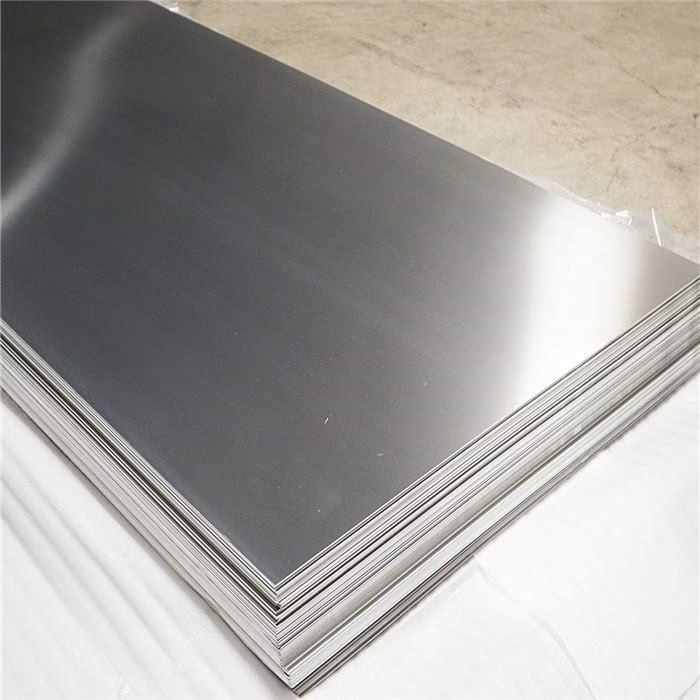
304 Stainless Steel Plate
AISI 304 (UNS S30400) is the most widely used austenitic stainless steel plate with 18% Cr and 8% Ni, offering excellent corrosion resistance, formability, and weldability. Thickness 3-200mm, width up to 2500mm, multiple surface finishes (No.1/2B/No.4/BA/No.8). Mill test certificate provided.
| Material | Austenitic Stainless Steel |
|---|---|
| Grade / Standard | AISI 304 / UNS S30400 |
| Thickness | 3mm - 200mm |
| Width | 1000mm - 2500mm |
| Length | 2000mm - 12000mm |
| Delivery Condition | hot_rolled / cold_rolled |
| Surface Treatment | coated |
| MOQ | 1 Ton |
| Delivery Time | 10-25 Days / In Stock |
| Loading Port | Tianjin / Shanghai / Qingdao |
Overview of 304 Stainless Steel Plate
AISI 304 is the most widely used austenitic stainless steel grade in the world, accounting for over 50% of global stainless steel production and consumption. Specified under ASTM A240 / EN 10088-2 standards with UNS designation S30400, 304 stainless steel plate offers an excellent combination of corrosion resistance, formability, weldability, and aesthetic appeal at a moderate cost. The grade contains nominally 18% chromium and 8% nickel, providing the characteristic austenitic microstructure with non-magnetic properties and exceptional toughness across a wide temperature range from cryogenic to 870°C.
304 stainless steel plate resists corrosion in atmospheric environments, fresh water, food and beverage processing chemicals, organic acids at moderate temperatures, and many industrial chemicals. The grade has become the international benchmark for general-purpose stainless steel applications requiring reliable corrosion resistance combined with cost-effective fabrication. For applications involving chloride exposure or higher operating temperatures, the molybdenum-bearing 316/316L grades or higher alloyed duplex stainless steels should be specified. 304 plate is supplied in a comprehensive thickness range from 3mm to 200mm with multiple surface finishes to meet diverse end-use requirements.
Key Features and Surface Finishes
304 stainless steel plate is manufactured through hot rolling for thicker gauges (typically over 6mm) or cold rolling for thinner sheets, followed by solution annealing at 1010-1120°C with rapid cooling to dissolve carbides and achieve optimal corrosion resistance. The plate is supplied in multiple surface finishes including No.1 (hot rolled, annealed, descaled — typical for thicker plates), 2B (cold rolled, annealed, pickled, light cold rolled — most common for general use), No.4 (brushed satin finish for architectural applications), BA (bright annealed mirror-like finish), and No.8 (mirror polish for decorative applications).
The plate is available in thickness from 3mm to 200mm and width up to 2500mm with standard length of 6 meters, with custom dimensions and cut-to-length service available. Each plate undergoes mandatory chemical composition analysis, mechanical property testing, intergranular corrosion testing per ASTM A262, and dimensional inspection to ensure full compliance with ASTM A240 / EN 10088-2 latest revision. PMI (Positive Material Identification) testing is available to verify grade composition for critical applications. The non-magnetic austenitic structure provides excellent formability for deep drawing, bending, and complex fabrication operations without losing corrosion resistance.
Main Applications of 304 Stainless Steel Plate
304 stainless steel plate is the primary material for food and beverage processing equipment including dairy processing tanks, brewery fermentation vessels, wine making equipment, food storage containers, commercial kitchen equipment, and meat processing systems where excellent corrosion resistance, easy cleaning, and FDA compliance are essential. The pharmaceutical and biotechnology industries use 304 plate for clean room equipment, sterile processing tanks, biopharmaceutical reactors, and laboratory workstation surfaces requiring CIP/SIP cleanability.
The chemical processing industry employs 304 plate for storage tanks handling dilute organic acids, mild alkalis, urea solutions, and many industrial chemicals at moderate temperatures. Architectural applications include building facades, decorative panels, elevator interiors, restaurant kitchens, public restroom fixtures, and exterior cladding for commercial buildings. Other major applications include water treatment plant equipment, swimming pool components, marine hardware (in non-chloride environments), automotive exhaust system components, household appliance bodies, hospital surgical equipment, sanitary ware, and a comprehensive range of consumer goods requiring corrosion-resistant stainless steel construction. The grade is also widely used in nuclear power plant non-pressure components, petrochemical heat exchanger shells, and renewable energy equipment manufacturing.
Why Choose Us for 304 Stainless Steel Plate
Shandong Tanglu Metal Material Co., Ltd. supplies premium 304 stainless steel plate sourced from major Chinese stainless steel mills including Tisco (Taiyuan Iron & Steel), Baosteel Stainless, and Lisco with proven international project experience and certified production facilities meeting ISO 9001, ISO 14001, ASME, and PED requirements. Every 304 plate undergoes mandatory chemical composition analysis (PMI verification available), mechanical property testing including tensile, yield, elongation, and hardness verification, intergranular corrosion testing per ASTM A262 Practice A or E, surface finish quality inspection, and dimensional inspection per ASTM A240 / EN 10088-2 latest revision.
We offer comprehensive thickness range from 3mm to 200mm in multiple surface finishes (No.1, 2B, No.4, BA, No.8) with standard widths up to 2500mm and lengths up to 12 meters, plus custom cutting service for specific project requirements. With monthly supply capacity of 5,000 tons of stainless steel plates and established export experience to food processing, pharmaceutical, chemical, architectural, and OEM clients in over 50 countries, we support both small trial orders and large project supply contracts. Each shipment includes original mill test certificate (MTC) conforming to EN 10204 3.1 standard, with EN 10204 3.2, PMI report, and third-party inspection (SGS, BV, ABS, DNV, LR) available for critical applications requiring enhanced documentation.
📐 Dimension & Size Table
| Thickness (mm) | Width (mm) | Length (mm) | Weight (kg/m²) |
|---|---|---|---|
| 3 | 1000-2000 | 2000-6000 | 23.95 |
| 4 | 1000-2000 | 2000-6000 | 31.93 |
| 5 | 1000-2000 | 2000-6000 | 39.92 |
| 6 | 1000-2000 | 2000-6000 | 47.90 |
| 8 | 1000-2200 | 2000-8000 | 63.86 |
| 10 | 1000-2200 | 2000-8000 | 79.83 |
| 12 | 1500-2200 | 3000-8000 | 95.79 |
| 16 | 1500-2200 | 3000-8000 | 127.72 |
| 20 | 1500-2500 | 3000-10000 | 159.65 |
| 25 | 1500-2500 | 3000-10000 | 199.56 |
| 30 | 1500-2500 | 3000-10000 | 239.48 |
| 40 | 1500-2500 | 3000-12000 | 319.30 |
| 50 | 1500-2500 | 3000-12000 | 399.13 |
| 60 | 1500-2500 | 3000-12000 | 478.95 |
| 80 | 1500-2200 | 3000-12000 | 638.60 |
| 100 | 1500-2200 | 3000-12000 | 798.25 |
| 150 | 1500-2000 | 3000-10000 | 1197.38 |
| 200 | 1500-2000 | 3000-8000 | 1596.50 |
* Custom sizes available upon request. Tolerances per relevant international standards.
🔬 Chemical Composition
| Element | Min | Max | Display Value | Note |
|---|---|---|---|---|
| C | - | 0.08 | ≤0.08 | Per ASTM A240 304 |
| Si | - | 0.75 | ≤0.75 | |
| Mn | - | 2.00 | ≤2.00 | |
| P | - | 0.045 | ≤0.045 | |
| S | - | 0.030 | ≤0.030 | |
| Cr | 18.00 | 20.00 | 18.00-20.00 | Corrosion resistance element |
| Ni | 8.00 | 10.50 | 8.00-10.50 | Austenite stabilizer |
| N | - | 0.10 | ≤0.10 | Optional |
| Fe | - | - | Balance | Base element |
* Chemical composition may vary by heat, thickness and specification. Please refer to the actual mill test certificate.
⚙️ Mechanical Properties
| Property | Value | Unit | Test Condition |
|---|---|---|---|
| Tensile Strength (Rm) | ≥515 | MPa | Solution annealed, per ASTM A240 |
| Yield Strength (Rp0.2) | ≥205 | MPa | 0.2% proof stress |
| Elongation (A) | ≥40 | % | Gauge length 50mm |
| Brinell Hardness (HBW) | ≤201 | HBW | Solution annealed |
| Rockwell Hardness (HRB) | ≤92 | HRB | Solution annealed |
| Vickers Hardness (HV) | ≤210 | HV | Solution annealed |
| Impact Energy (KV2) | ≥150 | J | Charpy V-notch at +20°C |
| Density | 7.93 | g/cm³ | Reference value |
| Magnetic Permeability | ≤1.02 | μ | Non-magnetic austenitic structure |
* Values shown are minimum requirements unless otherwise stated.
📦 Commercial Information
| Packaging | Standard seaworthy export packing for stainless steel plates. Thinner plates (≤6mm) packed with PE film wrapping individually, then bundled with steel strapping and protective wooden frame. Thicker plates (>6mm) bundled with steel strapping and edge protection corners, with weather-resistant paper between plates to prevent surface scratching. Bundle weight typically 3-5 tons depending on plate dimensions. Each bundle clearly tagged with heat number, grade designation (304 / S30400), dimensions, surface finish, and quantity. Custom packaging including vacuum-sealed wrapping for premium polished surfaces and wooden crates for air shipment available. |
|---|---|
| Payment Terms | T/T (Telegraphic Transfer),L/C (Letter of Credit),D/P (Documents against Payment),Western Union,PayPal |
| Price Term | FOB,CFR,CIF,EXW |
| Supply Capacity | 5,000 Tons/Month (Stainless Steel Plates) |
| Loading Port | Tianjin / Shanghai / Qingdao |
Why Choose Our 304 Stainless Steel Plate?
Mill Certified Premium Quality
304 stainless steel plate supplied with original mill test certificate EN 10204 3.1/3.2, including chemical analysis (PMI verification available), mechanical properties, intergranular corrosion test per ASTM A262, surface finish inspection, and complete heat number traceability per ASTM A240 standard.
Comprehensive Thickness Range
Thickness range from 3mm precision sheets to 200mm heavy plates, with widths up to 2500mm and lengths up to 12 meters. Custom cutting service supported for specific project requirements with precision dimensional tolerance per ASTM A480.
Multiple Surface Finish Options
Five standard surface finishes available: No.1 (hot rolled annealed for thick plates), 2B (most common for general use), No.4 (brushed satin for architectural), BA (bright annealed for mirror appearance), and No.8 (mirror polish for decorative applications).
FDA & Multi-Industry Compliance
FDA compliant for food contact applications, with ISO 9001, CE / PED, ABS, DNV GL, Lloyd's Register, BV, SGS, NK, and RINA certifications. Suitable for food processing, pharmaceutical, chemical, marine, and architectural projects requiring code-compliant stainless steel.
Fast Stock Delivery Worldwide
Common thicknesses (3mm-30mm) maintained in large stock for 7-15 days dispatch. Thicker plates (40mm+) production cycle 25-35 days. Container loading optimized for 25-27 tons per 20FT FCL or 27-29 tons per 40FT FCL with proper edge protection.
🏭 Applications of 304 Stainless Steel Plate
304 stainless steel plate is the primary material for food and beverage processing equipment including dairy processing tanks, brewery fermentation vessels, wine making equipment, food storage containers, commercial kitchen equipment, meat processing systems, and beverage bottling lines where excellent corrosion resistance, easy cleaning, and FDA compliance are essential. The pharmaceutical and biotechnology industries use 304 plate for clean room equipment, sterile processing tanks, biopharmaceutical reactors, vaccine production equipment, and laboratory workstation surfaces requiring CIP/SIP cleanability and contamination-free operation. Chemical processing applications include storage tanks for dilute organic acids, mild alkalis, urea solutions, fertilizer production, and many industrial chemicals at moderate temperatures. Architectural applications cover building facades, decorative cladding panels, elevator interiors, escalator components, restaurant kitchens, public restroom fixtures, museum displays, and exterior cladding for commercial buildings, hotels, airports, and high-end residential developments. Other major applications include water treatment plant equipment, desalination plant components (in non-chloride environments), swimming pool fixtures, marine hardware, automotive exhaust system components, household appliance bodies, hospital surgical equipment, sanitary ware, dental clinic equipment, and a comprehensive range of consumer goods requiring corrosion-resistant stainless steel construction. The grade is also widely used in nuclear power plant non-pressure components, petrochemical heat exchanger shells, paper and pulp processing equipment, and renewable energy equipment manufacturing.
📋 Quality & Certification
Our Certifications
- ✅ ISO 9001:2015
- ✅ CE Marking
- ✅ ABS
- ✅ DNV GL
- ✅ Lloyd's Register (LR)
- ✅ Bureau Veritas (BV)
- ✅ SGS Certified
- ✅ NK
- ✅ RINA
Mill Certificate Type
- 📋 EN 10204 3.1
- 📋 EN 10204 3.2
- 📋 Original Mill Certificate
- 📋 Third Party Inspection Available
- 📋 Certificate of Origin
❓ Frequently Asked Questions
What is 304 stainless steel plate?
304 is the most widely used austenitic stainless steel grade specified under ASTM A240 / EN 10088-2 standards with UNS designation S30400. It contains nominally 18% chromium and 8% nickel, providing the characteristic non-magnetic austenitic microstructure with excellent corrosion resistance, formability, and weldability at moderate cost. 304 stainless steel plate accounts for over 50% of global stainless steel production and is the international benchmark for general-purpose stainless steel applications including food processing, pharmaceutical, chemical processing, architectural, and consumer goods manufacturing.
What is the difference between 304 and 304L stainless steel?
The main difference is carbon content. 304 has maximum carbon of 0.08%, while 304L has maximum carbon of 0.030% (the 'L' stands for 'Low carbon'). The lower carbon content in 304L provides better resistance to intergranular corrosion (also called sensitization) in heat-affected zones after welding, making 304L the preferred choice for welded fabrications that cannot be solution annealed after welding. 304L is mandatory for thicker welded sections (typically over 6mm) and chemical processing equipment, while 304 is acceptable for thin sections, mechanical fasteners, and applications where post-weld heat treatment is performed. Mechanical properties of 304L are slightly lower than 304 (yield 170 MPa vs 205 MPa) due to reduced carbon strengthening.
What is the equivalent grade of AISI 304?
AISI 304 has equivalent grades in major international standards: UNS S30400 (US Unified Numbering System), ASTM A240 304 (American specification), EN 1.4301 / X5CrNi18-10 (European standard EN 10088), JIS SUS304 (Japanese standard JIS G4304), GB 06Cr19Ni10 / 0Cr18Ni9 (Chinese standard GB/T 4237), DIN X5CrNi18-10 (German standard), and AFNOR Z6CN18-09 (French standard). All these grades share virtually identical chemical composition (18% Cr, 8% Ni base) and mechanical properties, making them interchangeable for most engineering applications. EN 1.4301 is the most commonly referenced equivalent in European projects, while SUS304 is the standard designation in Japanese manufacturing.
What surface finishes are available for 304 stainless steel plate?
304 stainless steel plate is available in five standard surface finishes per ASTM A480: No.1 finish (hot rolled, annealed, and descaled — typical for plates >6mm thick used in industrial equipment), 2B finish (cold rolled, annealed, pickled, and lightly cold rolled — most common for general use, smooth reflective surface), No.4 finish (brushed satin finish with linear graining — popular for architectural applications, restaurant equipment, and appliances), BA finish (bright annealed, mirror-like reflective surface achieved by annealing in protective atmosphere — used for decorative panels and food contact surfaces), and No.8 finish (mirror polish achieved by progressive grinding and polishing — used for high-end decorative applications, elevator panels, and luxury fixtures). Custom finishes including hairline, embossed, and patterned available upon request.
Can 304 stainless steel be used in marine or chloride environments?
304 stainless steel has limited resistance to chloride-induced corrosion and is generally NOT recommended for direct contact with seawater, marine atmospheres with high salt spray, or chloride-containing chemicals at elevated temperatures. In these environments, 304 is susceptible to pitting corrosion, crevice corrosion, and stress corrosion cracking (SCC). For marine applications, 316/316L (containing 2-3% molybdenum) provides significantly better chloride resistance and is the preferred choice. For aggressive marine environments such as splash zones, offshore platforms, or desalination equipment, 2205 duplex stainless steel or 904L super austenitic grades should be specified. 304 is suitable for indoor coastal architectural applications, freshwater marine equipment, and properly designed marine accessories with appropriate maintenance schedules.
Get a Quote for
304 Stainless Steel Plate
Submit your requirements and receive a competitive price quote within 24 hours.
- ✓ Fast response within 24 hours
- ✓ Competitive factory-direct pricing
- ✓ Free technical consultation
- ✓ Mill test certificate provided
- ✓ Flexible payment terms available
⏱ Response within 24 hours
Send Your Inquiry
All fields marked with * are required